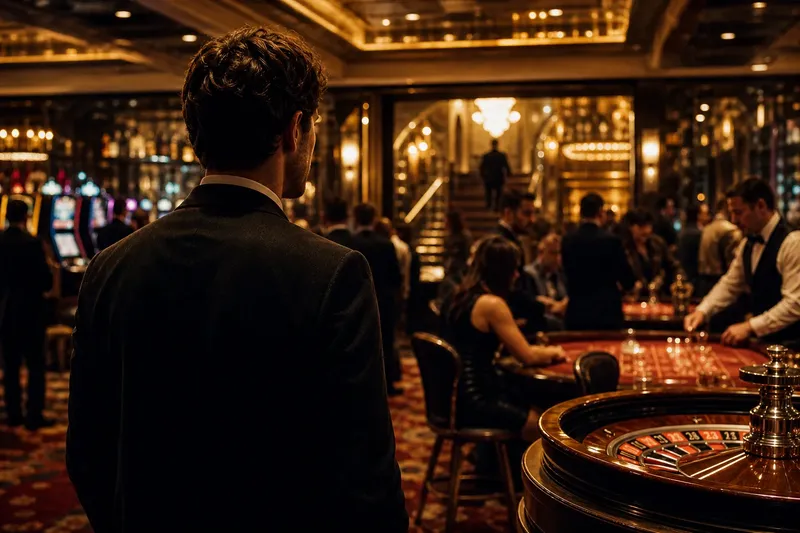
From Private Rooms to Public Spectacle: The Changing Casino Image
The changing casino image shows how venues balanced public display with selective access, helping you distinguish advertised welcome from rules of entry.
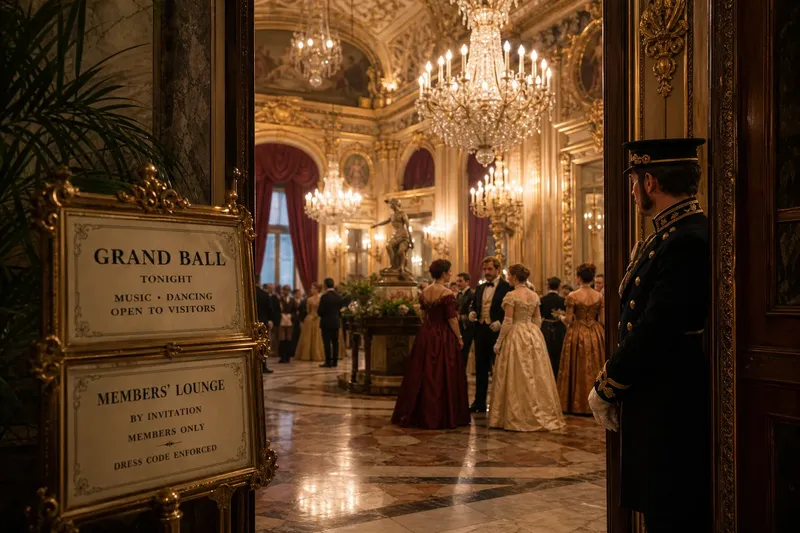
A nineteenth-century travel illustration shows a brightly lit casino foyer, with a guarded doorway farther inside. The changing casino image invites a useful question: what could visitors see, and who could go beyond the display?
Read the changing casino image through its setting
The word “casino” has described different kinds of venues, and the name alone cannot tell you who was admitted. Identify the place and period, then consult local rules and contemporary descriptions rather than treating gambling rooms across Europe as one uniform institution.
For a particular venue, look for admission notices, club rules, guidebooks, newspaper advertisements and architectural records. Each source has a different purpose: an advertisement promotes the venue, while an admission notice may set out conditions for entry.
Keep the venue, date and source beside each claim. If one is unknown, mark the claim as provisional.
Distinguish public display from access
A prominent entrance, decorative foyer or advertised concert could make a venue visible to passers-by. None of these details alone establishes that every visitor could enter every room or take part in every activity.
Compare the venue’s public image with evidence about admission. Look for membership requirements, invitations, dress expectations, age limits or other stated conditions. Separate written rules from social conventions reported by an observer.
Imagine a fictional seaside venue with a poster advertising a ballroom and a separate notice reserving a lounge for members. The poster shows that the venue promoted public entertainment; the notice identifies a restricted area. Unless another source describes how the rules were applied, neither document settles that question.
When sources differ, record what each says and why they may differ.
Use visual details to frame questions
Interiors and publicity can reveal how a casino wished to be seen. They do not, by themselves, describe every visitor’s experience, the rules at the door or the people left out of the image.
- Check the entrance shown. If it is prominent, describe the venue’s visible approach; if it is hidden or absent, seek another image or written description before making a claim about access.
- Check which rooms are identified. If a public lounge and private room are both labelled, keep their stated purposes separate; if the image has no labels, look for another source before assigning a use.
- Check who appears in the publicity. If guests are named or described, compare that account with admission rules; if they are anonymous, do not infer their status from appearance alone.
- Check the viewpoint and framing. If the image is staged or tightly cropped, describe only what it depicts; if its context is unclear, find a better-documented image before treating it as representative.
- Check the date and provenance. If both are supplied, compare the image with material from the same period; if either is missing, mark the interpretation as uncertain and seek a dated source.
- Check claims about rules against a written record. If a notice or regulation supports them, note that source; if none does, describe the rule as unverified and look for a local record.
A picture can show the room’s intended impression; a rule or account is needed to describe entry conditions.
What can a historical casino image establish?
Does a grand entrance prove that a casino welcomed everyone?
No. It shows that the entrance was made visible or impressive, but admission may still have depended on written rules or social expectations. Consult a contemporary notice or local account before making a claim about access.
How can I tell whether a room was private?
Look for a label, membership rule, invitation notice or contemporary description that identifies its use. If sources disagree, report the difference rather than treating the room’s appearance as decisive.
Are posters reliable records of casino life?
Posters are evidence of how a venue advertised itself, not a complete record of who attended or what happened inside. Compare their claims with admission notices, guidebooks or local reporting from the same period.
What should I do when sources tell different stories?
Note each source’s date, purpose and audience, then state what it supports. An advertisement may promote openness while a club notice sets limits; describe both without trying to make them say the same thing.
Compare sources before making a claim
Choose one named venue and a defined period, then gather material with different purposes: an image for presentation, an admission notice for stated rules and a contemporary description for reported experience. Record what each source says directly and what remains an interpretation.
- Name the venue and period. If the source identifies both, use them to frame your claim; if not, avoid attaching it to a precise place or date.
- Identify the source type. If it is an advertisement, treat it as promotion; if it is a rule or official notice, use it to describe the stated conditions of entry.
- Describe visible evidence. If a room, sign or entrance is clear, record that detail; if it is obscured, do not guess what lies outside the frame.
- Compare a second source. If it supports the same detail, say the sources agree; if it differs, preserve the disagreement and consider each source’s purpose.
- Write a bounded conclusion. If the evidence establishes public display but not equal admission, make only the first claim; if it establishes neither, say the material is inconclusive.
Say you find a fictional resort poster showing a public ballroom and a dated membership notice reserving a side lounge. You record what each document says, then check that both refer to the same venue and period. If they do, you can conclude that the resort promoted public entertainment while maintaining at least one restricted space; you cannot conclude how consistently the restriction was enforced. If the dates or locations do not match, keep the documents separate and make no claim that they describe the same arrangement.
Keep visibility and admission distinct
When interpreting the changing casino image, distinguish what a venue displayed, what its rules stated and what an observer reported. A foyer may have been designed to attract attention, while a notice set limits and a travel account reflected one visitor’s perspective.
That distinction helps you describe both the public image and the limits of the evidence. A striking room belongs in the story, but it cannot stand in for everyone who entered—or for those who could not.